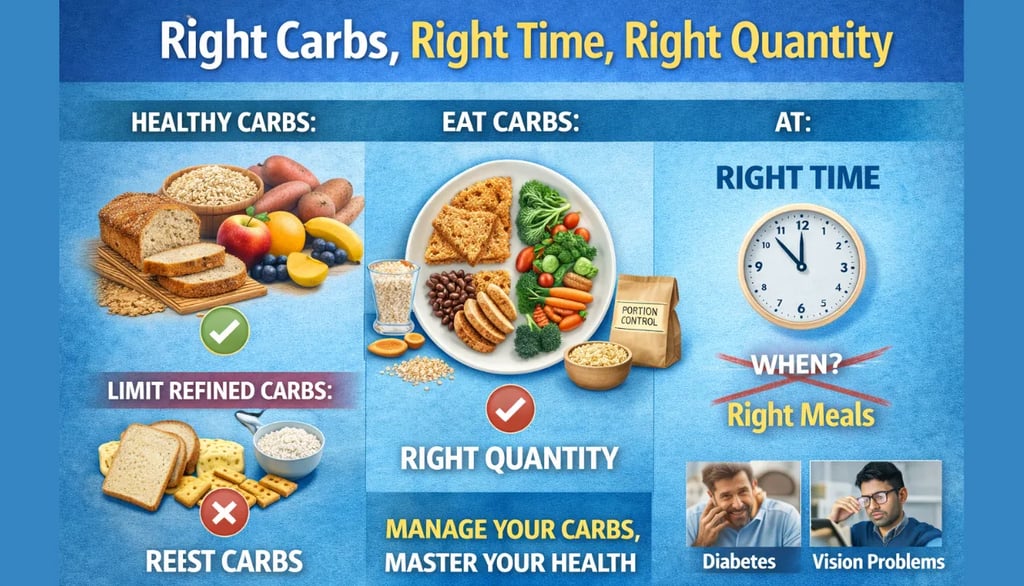
Right Carbs, Right Time, Right Quantity
For decades, Indians have been taught that a healthy meal means a generous helping of rice or a stack of soft rotis. Our mothers and grandmothers measured a meal's success by how many rotis we ate or whether we finished every grain of rice on our plates. Carbohydrates are not just food in India—they are love, tradition, comfort, and celebration.
ASF
3/5/202615 min read
For decades, Indians have been taught that a healthy meal means a generous helping of rice or a stack of soft rotis. Our mothers and grandmothers measured a meal's success by how many rotis we ate or whether we finished every grain of rice on our plates. Carbohydrates are not just food in India—they are love, tradition, comfort, and celebration.
But this deep-rooted relationship with carbs has come at a steep price. With over 101 million Indians living with diabetes and another 136 million in the prediabetic stage, the way we consume carbohydrates has become a matter of national health emergency. The problem, however, is not carbohydrates themselves. The problem is that we have been eating the wrong carbs, at the wrong time, in the wrong quantities.
This comprehensive guide introduces a simple yet transformative framework: Right Carbs, Right Time, Right Quantity. Grounded in the latest 2024 dietary guidelines from the National Institute of Nutrition (NIN) and the Indian Council of Medical Research (ICMR), this approach respects our culinary traditions while adapting them to the realities of modern, sedentary living. You do not need to abandon your favourite foods. You need to learn how to choose them wisely, time them strategically, and portion them correctly.
1. Introduction: Why the "Three Rights" Matter More Than Ever
1.1 The Indian Carbohydrate Conundrum
India's dietary landscape is dominated by carbohydrates. In many households, cereals—rice and wheat—contribute 50% to 70% of total daily energy intake. This stands in stark contrast to the ICMR's recommendation that cereals and millets should provide no more than 45% of total calories.
The consequences of this carbohydrate overload are evident in our health statistics. The ICMR-NIN estimates that 56.4% of the total disease burden in India is attributable to unhealthy diets. Non-communicable diseases (NCDs) now account for 6.3 million deaths annually in India—68% of all mortality.
But here is the crucial insight: carbohydrates are not the enemy. They are our body's primary fuel source, essential for energy, brain function, and physical activity. The enemy is the type of carbohydrates we consume, the timing of their consumption, and the quantities we pile onto our plates.
1.2 Understanding the Framework
The "Right Carbs, Right Time, Right Quantity" framework addresses all three dimensions:
Right Carbs: Choosing carbohydrates with high fibre content and low glycemic index that provide sustained energy without dangerous blood sugar spikes.
Right Time: Aligning carbohydrate consumption with our body's natural rhythms and activity patterns to optimize glucose utilisation.
Right Quantity: Controlling portions using simple visual tools that work with our traditional dining culture.
This framework is not a restrictive diet. It is a sustainable approach to eating that allows you to enjoy your favourite foods while protecting your metabolic health.
2. Understanding Carbohydrates: The Foundation
2.1 What Are Carbohydrates?
Carbohydrates are one of the three macronutrients (along with proteins and fats) that provide energy to the body. They are broken down into glucose, which enters the bloodstream and fuels our cells, tissues, and organs.
The ICMR-NIN classifies carbohydrates into several categories :
Simple Carbohydrates: Glucose and fructose are found naturally in fruits and vegetables; sucrose (table sugar) and lactose (milk sugar).
Complex Carbohydrates: Starches found in cereals, millets, pulses, and root vegetables; glycogen in animal foods.
Dietary Fibre: Cellulose in vegetables and whole grains; gums and pectins in vegetables. These are resistant to human digestion but crucial for health.
2.2 The Glycemic Index: A Tool for Choosing Right
The glycemic index (GI) measures how quickly a carbohydrate-containing food raises blood glucose levels. Foods are classified as :
Low GI (0–55): Slow digestion and absorption; gradual rise in blood sugar
Medium GI (56–69): Moderate effect on blood sugar
High GI (70+): Rapid digestion and absorption; sharp spike in blood sugar
For Indians managing diabetes or prediabetes, choosing low-GI foods is a cornerstone of dietary management. However, GI alone does not tell the whole story. The glycemic load (GL) accounts for both the GI and the portion size, providing a more practical picture of how a food affects blood sugar.
2.3 Why Fibre Matters
Dietary fibre is the indigestible part of plant foods. The ICMR-NIN emphasizes that fibre :
Delays and retards the absorption of carbohydrates and fats
Increases satiety value, helping with weight management
Reduces glucose and lipids in the blood
Improves insulin sensitivity
The 2024 guidelines recommend a daily fibre intake of 25–30 grams from food sources .
3. Right Carbs: Choosing Wisely in the Indian Kitchen
3.1 The 2024 ICMR-NIN Recommendations
The latest dietary guidelines provide clear direction on carbohydrate quality :
Whole grains: At least 50% of cereal intake should come from whole grains
Added sugar: Less than 5% of total calories (approximately 20–25 grams per day)
Vegetable intake: 400 grams per day, including 100 grams of green leafy vegetables
Dietary diversity: Macronutrients and micronutrients should come from a minimum of eight food groups
3.2 Low-Glycemic Indian Foods
Here is a comprehensive guide to low-GI Indian foods that should form the foundation of your diet :
Cereals and Millets:
Barley (jau)
Oat bran
Daliya (broken wheat)
Quinoa
Poha (flattened rice) in moderation
Millets: jowar (sorghum), bajra (pearl millet), ragi (finger millet), foxtail millet (kangni)
Pulses and Legumes (all excellent low-GI options):
Green gram (moong dal)
Black-eyed peas (lobia)
Chickpea (chana)
Kidney bean (rajma)
Soybean
All dals and pulses
Vegetables:
All green leafy vegetables: spinach (palak), fenugreek (methi), amaranth (chaulai)
Cruciferous vegetables: broccoli, cauliflower, cabbage
Gourd family: bottle gourd (lauki), bitter gourd (karela), ridge gourd (tori)
Other low-starch options: brinjal, tomato, cucumber, beans, peas (in moderation)
Fruits:
Apple
Apricot
Grapefruit
Orange
Kiwi
Peach
Pear
Berries
Plum
Raw banana
Dairy:
Milk
Plain yogurt (dahi)
Greek yogurt
Paneer
Buttermilk (chaas)
Nuts and Seeds:
Almonds (badam)
Walnuts (akhrot)
Peanuts (moongphali)
Flaxseeds (alsi)
Sunflower seeds
Pumpkin seeds
3.3 Medium-Glycemic Indian Foods (Consume in Moderation)
Muesli
Rye
Brown rice
Sweet potato (shakarkandi)
Ripe banana
Grapes
Muskmelon (kharbooja)
Papaya
Pineapple
Dry fruits (figs, raisins)
Honey
3.4 High-Glycemic Indian Foods (Limit or Avoid)
White rice (especially highly polished varieties)
Cornflakes and processed breakfast cereals
Instant oats
Rice porridge (pongal, khichdi made with polished rice)
Pumpkin (kaddu)
Watermelon
White potato (aloo)
Russet potatoes
Sugar, jaggery (gur)
Soft drinks and packaged juices
Pizza, fast food
Chocolate
Flavoured yogurt
Rice milk
3.5 The Truth About "Healthy" Sweeteners
There is considerable confusion surrounding jaggery (gur), honey, and brown sugar. Despite their "healthy" image, they raise blood glucose similarly to table sugar. They are still "free sugars" and should be limited to the recommended less than 5% of total calories.
A simple victory: cutting just one teaspoon of sugar from tea or coffee twice daily saves roughly 8–10 grams of sugar daily—that amounts to 240–300 grams less free sugar per month.
3.6 Smart Cooking Strategies to Lower GI
The way you cook can significantly affect the glycemic impact of foods :
Cook rice al dente: Overcooked rice has a higher glycemic index. Soak, rinse, and cook until just done—not mushy.
Cool and reheat: Cooling cooked rice or potatoes increases resistant starch, which is harder to digest and has a lower impact on blood sugar.
Sprout legumes: Sprouting increases nutrient availability and reduces glycemic impact.
Add acidity: Adding vinegar, lemon juice, or amchur (dried mango powder) to meals can lower the glycemic response.
Use pressure cooking wisely: While pressure cooking is efficient, avoid overcooking legumes to the point of complete mushiness.
4. Right Time: When to Eat Your Carbs
4.1 The Science of Meal Timing
Consistent meal timing helps improve insulin sensitivity and reduces overeating . Our bodies process carbohydrates differently depending on the time of day, our activity levels, and the composition of our meals.
The concept of chrono-nutrition—aligning food intake with our circadian rhythms—suggests that carbohydrate tolerance is generally better earlier in the day when insulin sensitivity is higher.
4.2 The "Vegetables First" Strategy
Research shows that the order in which you eat your food affects post-meal glucose spikes. The "vegetables first" approach—starting meals with fibre-rich vegetables, followed by protein, and then carbohydrates—can significantly lower post-meal blood glucose.
This strategy works because:
Fibre slows gastric emptying
Protein stimulates insulin secretion and slows digestion
Carbohydrates encounter a digestive system already processing other nutrients, leading to slower glucose absorption
4.3 Pairing Carbs with Protein and Fat
One of the most effective strategies for managing blood sugar is to never eat carbohydrates alone . Pairing carbs with protein and healthy fats:
Slows digestion and glucose absorption
Reduces post-meal glucose spikes
Increases satiety, preventing overeating
Provides sustained energy
Practical examples:
Dal with rice (the classic Indian combination is scientifically sound!)
Paneer with roti
Curd with poha
Sprouts with vegetable upma
Eggs with toast
4.4 Timing Around Physical Activity
If you exercise, timing your carbohydrate intake around your workouts can optimise energy utilization :
Before exercise: A small carbohydrate-rich snack 1–2 hours before activity provides fuel
After exercise: Consuming carbohydrates within 2 hours of exercise helps replenish glycogen stores
For those with sedentary lifestyles, carbohydrate intake should be concentrated earlier in the day when physical activity is higher, with lighter carbohydrate meals in the evening.
4.5 The Evening Taper
Many Indians consume their largest carbohydrate load at dinner—often rice or multiple rotis followed by dessert. This pattern is metabolically disadvantageous because:
Evening insulin sensitivity is lower
Physical activity after dinner is minimal
Glucose from evening meals has nowhere to go but storage
Consider shifting more carbohydrates to lunch and having a protein-rich, vegetable-heavy dinner with minimal grains.
5. Right Quantity: Mastering Portion Control
5.1 The Plate Method: A Visual Guide
The ICMR-NIN recommends the "My Plate for the Day" approach, where vegetables, fruits, green leafy vegetables, roots, and tubers form essentially half the plate. This visual method eliminates the need for calorie counting while ensuring balanced nutrition.
Here is how to build your plate :
Half the plate (50%): Non-starchy vegetables
Bhindi, lauki, cabbage, leafy greens, cauliflower, broccoli, beans
Cook them with minimal oil
This is non-negotiable—half your plate must be vegetables
One-quarter of the plate (25%): Quality carbohydrates
Whole wheat roti, brown rice, parboiled/basmati rice, millets
Either rice OR roti, not both (unless you halve each portion)
One-quarter of the plate (25%): Protein
Dal, chana, rajma, paneer, soya chunks, fish, chicken, eggs
This is the space it gets
On the side: Small bowl of curd, salad, pickle (these don't count toward main plate divisions)
5.2 Your Hand as a Portion Guide
Your body comes with built-in measuring tools—your hands. Hand size generally matches body size, so portions are naturally personalized :
Palm (without fingers): Protein portion (paneer, chicken, fish, dal)
Fist: Vegetable serving
Cupped hand: Carbohydrate portion (rice, roti)
Thumb: Fat serving (ghee, oil, butter)
This guide works everywhere—at home, restaurants, weddings, and family gatherings.
5.3 Practical Portion Guidelines for Indian Foods
Rice: One traditional steel katori (small bowl), level, not heaped—roughly one cupped hand or computer mouse size .
Roti: One roti is a standard portion. Two if you are active or skipped rice. Three or more only if you perform physical labour, not desk work .
Rice and roti together: If you must have both, take half portions of each. One-quarter of your plate is the total carbohydrate space—whether that is one roti, one katori of rice, or half of each .
Dal: One small katori is plenty. If dal is your main protein, you can have a bit more.
Protein (paneer, chicken, fish): The size of your palm or a deck of cards.
Vegetables: Fill half your plate—more is better. Potatoes and other starchy vegetables count toward carbohydrates, not the vegetable portion.
Oil and ghee: One tablespoon per meal—approximately your thumb tip . This sounds small because we have normalized drowning food in oil.
5.4 The Psychology of Smaller Plates
Your brain is easily fooled by visual cues. When you put food on a smaller plate, it looks like more food. Studies prove that people eating from smaller plates feel just as satisfied as those eating larger portions from bigger plates.
Many families have lost 2–3 kilograms simply by switching from 12-inch dinner plates to 9-inch plates—no dieting, no struggle.
5.5 Carbohydrate Counting for Insulin Users
For those on insulin, carbohydrate counting becomes essential. Here are approximate carb counts for common Indian foods :
1 medium chapati (whole wheat): ~15 grams carbs
1 medium idli: ~12–15 grams carbs
1 plain medium dosa: ~30 grams carbs
1 cup cooked white rice: ~45 grams carbs
1 cup cooked parboiled/basmati rice: ~40–45 grams carbs
1 cup cooked millets: ~35–40 grams carbs
1 cup cooked rajma/chana: ~30–35 grams carbs
5.6 The One-Quarter Rule for Cereals
The ICMR emphasises that a balanced diet should provide not more than 45% calories from cereals and millets. In practical terms, this means cereals should occupy no more than one-quarter of your plate—a significant reduction for most Indians.
6. Regional Adaptations: The Framework Across India
One of the strengths of this framework is its flexibility across India's diverse culinary traditions.
6.1 North Indian Diet
Typical meal: Wheat-based rotis, dal, sabzi, raita, salad.
Application:
Fill half your plate with sabzi (seasonal vegetables)
One roti as your carbohydrate quarter (two if very active)
Dal as your protein quarter
Raita and salad on the side
Smart swap: Replace one roti with a mix of whole wheat and besan (chickpea flour) for added protein.
6.2 South Indian Diet
Typical meal: Rice, sambar, rasam, poriyal (vegetable stir-fry), curd.
Application:
One katori of rice (not heaped) as your carbohydrate quarter
Sambar (lentils + vegetables) as your protein quarter
Poriyal and other vegetable dishes to fill half your plate
Curd on the side
Smart swap: Replace a portion of white rice with millets or parboiled rice. Make idlis and dosa with added urad dal for protein.
6.3 East Indian Diet
Typical meal: Rice, fish curry, dal, green leafy vegetables (saag).
Application:
One katori of rice as carbohydrate quarter
Fish curry (fish provides protein)
Saag and other vegetables to fill half the plate
Dal as additional protein if needed
Smart swap: Use mustard oil (healthy fat) in moderation. Balance rice with generous vegetable portions.
6.4 West Indian Diet
Typical meal: Jowar/bajra roti, vegetable subzi, dal, buttermilk.
Application:
One roti as a carbohydrate quarter (millets are excellent low-GI options)
Subzi to fill half your plate
Dal as a protein quarter
Buttermilk on the side
Smart swap: Pair with peanut chutney for added protein and healthy fats.
6.5 Gujarati Thali
Typical meal: Roti or rice, dal, kadhi, shaak (vegetable), farsan (snack), mithai (sweet).
Application :
Fill your thali once, following the plate proportions
One carbohydrate: either roti OR rice (not unlimited refills)
Vegetable shaak fills half the space
Dal/kadhi as protein
One small piece of mithai, eaten slowly after the meal
Do not go back for more kadhi or that third puri
6.6 Punjabi Food
Typical meal: Paratha, chole, paneer, makhan, cream-based curries.
Application :
One paratha instead of two
Palm-sized portion of paneer or chole
Huge salad to fill half the plate
The makhan and cream in the curry count as your fat quota for the meal
7. Festival and Special Occasion Strategies
Nobody wants to count carbs at Diwali or a wedding. Here are practical strategies for celebrations :
7.1 The One-Plate Rule at Buffets
Walk the entire buffet first to see everything available
Take one plate and fill it using the plate method:
Half vegetables and salads
Quarter protein items
Quarter carbs
Enjoy it slowly, taste everything you want, then stop
7.2 At Family Celebrations
When relatives insist you eat more, have responses ready :
"It was delicious, I'm genuinely full"
"I'll take some home"
"Doctor said I need to watch portions" (blame the doctor—most Indian parents respect doctors' orders)
7.3 Festive Sweets
Pick your favourite sweet and have one small piece
Eat it slowly, savouring every bite
Pair sweets with protein or fibre (e.g., a small piece of barfi after a protein-rich meal, not on an empty stomach)
Then move away from the sweet table
The "share and savour" strategy: share one sweet among 2–3 people
7.4 Strategic Planning
If you know there is a heavy meal in the evening, eat lighter at lunch
Increase physical activity during festival periods
This is strategic planning, not deprivation
The goal during festivals is not perfection—it is damage control.
8. Sample 7-Day Meal Plan
Here is a week-long meal plan that demonstrates the "Right Carbs, Right Time, Right Quantity" framework.
Day 1
Breakfast: Vegetable upma made with millet (1 katori), paired with curd (1 small bowl)
Lunch: 2 whole wheat rotis, paneer bhurji (palm-sized portion), mixed vegetable curry (half plate), salad
Dinner: Grilled fish (palm-sized) with sautéed vegetables (half plate), 1 multigrain roti
Snack: Roasted chana (small handful)
Day 2
Breakfast: Moong dal cheela (2) with mint chutney
Lunch: 1 katori brown rice, dal (1 katori), bhindi sabzi (half plate), curd (1 small bowl)
Dinner: Methi thepla (1) with curd and cucumber salad (half plate)
Snack: A handful of almonds and walnuts
Day 3
Breakfast: Sprouts chaat (1 katori) with lemon juice
Lunch: Quinoa khichdi (1 katori) with mixed vegetables, curd on the side
Dinner: Besan chilla (2) with green chutney and buttermilk
Snack: Buttermilk (unsweetened)
Day 4
Breakfast: Ragi porridge (1 bowl) with nuts
Lunch: 2 whole wheat rotis, chole (palm-sized portion), cabbage sabzi (half plate), salad
Dinner: Tandoori chicken (palm-sized) with grilled vegetables (half plate), 1 roti
Snack: Makhana (roasted fox nuts)
Day 5
Breakfast: Vegetable poha (1 katori) with added peanuts and curd
Lunch: 1 katori parboiled rice, fish curry (palm-sized fish), lauki sabzi (half plate)
Dinner: Palak paneer (palm-sized portion of paneer) with 1 jowar roti, cucumber salad
Snack: Apple with peanut butter (1 tablespoon)
Day 6
Breakfast: 2 idlis with sambar (generous serving) and coconut chutney
Lunch: 1 katori millet rice, rajma (palm-sized portion), green bean poriyal (half plate)
Dinner: Mixed vegetable soup (1 bowl), grilled chicken salad (half plate with palm-sized chicken)
Snack: Roasted chana or murmura (puffed rice) with onions and peanuts
Day 7
Breakfast: Besan chilla (2) with mint chutney
Lunch: 2 bajra rotis, baingan bharta (half plate), dal (1 katori)
Dinner: 1 katori brown rice, vegetable stew with tofu (palm-sized tofu), thoran (half plate)
Snack: Greek yogurt with berries
9. Common Mistakes and How to Avoid Them
9.1 The Roti vs. Rice Debate Trap
People get obsessed with whether roti or rice is "better" and completely miss the point . It does not matter which one you choose—what matters is how much you eat. Three rotis are not healthier than one katori of rice just because they are made from wheat. They are both carbohydrates and both spike blood sugar if overconsumed.
The real question is not "roti or rice?" but "how much?" And the answer is one-quarter of your plate.
9.2 Hidden Calories in Indian Cooking
Here is what trips everyone up: the "invisible" additions :
That tadka (tempering) in your dal? Two tablespoons of ghee
The oil that the sabzi is swimming in? Easily three tablespoons
Is the malai (cream) in the restaurant paneer? Significant hidden fat
Sugar in chai, ghee on roti, oil in parathas
Watch how food is cooked. If you see oil pooling on top of the curry, that is too much. Healthy Indian cooking can achieve amazing flavour with one tablespoon of oil if you use the right spices.
9.3 The "Wasting Food is Bad" Mentality
We have all heard it: "Finish your plate! Think of the starving children!" . This well-meaning guilt trip has created a generation of overeaters.
Forcing yourself to overeat does not help anyone. Those starving children do not benefit from you being uncomfortably full. You are not honouring food by eating past fullness—you are making yourself unhealthy.
The solution: start with smaller portions. Use the plate method, and you will naturally waste less food. Leftovers can be saved for tomorrow's lunch.
9.4 Ignoring Protein
The Indian diet, traditionally carbohydrate-heavy, often lacks adequate protein. This is problematic because protein:
Provides satiety
Preserves muscle mass (the body's metabolic engine)
Has minimal impact on blood sugar
Slows glucose absorption when paired with carbs
Include a protein source at every meal and snack.
9.5 Not Reading Food Labels
Hidden sugars lurk in packaged foods: ketchup, "health drinks," flavoured curd, cereals, and energy bars . Always check the label for added sugar aliases—maltose, fructose syrup, invert sugar, jaggery syrup.
If sugar appears among the first three ingredients, the product is likely nutritionally poor.
9.6 Falling for Protein Supplement Marketing
The ICMR-NIN specifically warns against protein supplements for building body mass. Prolonged intake of large amounts of protein powders has been associated with potential dangers, including bone mineral loss and kidney damage. Protein intake levels greater than 1.6g/kg body weight/day do not contribute further to muscle gains.
Get your protein from real foods: dals, legumes, dairy, eggs, fish, and lean meats.
10. Special Populations
10.1 Pregnant and Lactating Women
The 2024 ICMR guidelines provide specific recommendations for pregnancy and lactation :
Pregnancy:
Second trimester: +8 grams protein daily
Third trimester: +18 grams of protein daily
Calcium supplementation (1 gram/day) from 14 weeks
Iron-folic acid (30–60 mg elemental iron, 400 μg folic acid)
Enhanced focus on the "1000-day nutrition" concept (conception to the child's second birthday)
Lactation:
Continued emphasis on nutrient-dense foods
Adequate hydration
Inclusion of oil seeds, nuts, beans, and fish to meet higher fat and essential fatty acid requirements
10.2 Children and Adolescents
The 2024 guidelines address the dual burden of malnutrition and obesity in children :
Detailed BMI categories for different age groups
Screen time management: >3 hours/day screen time recognised as a risk factor for obesity and metabolic dysfunction
Family-based interventions for obesity prevention
Healthy school meals limiting added sugars
10.3 Older Adults
As we age, muscle preservation becomes crucial. Adequate protein intake combined with resistance exercise helps maintain muscle mass and metabolic health. Carbohydrate quality becomes even more important as insulin sensitivity naturally declines.
11. Putting It All Together: Your Action Plan
11.1 Start with Awareness
Before changing anything, spend one week observing your current eating patterns. Ask yourself:
What types of carbohydrates am I eating?
When am I eating them?
How much is on my plate?
How do I feel after meals?
11.2 Make One Change at a Time
Sustainable change happens gradually. Try these modifications one at a time:
Week 1-2: Implement the plate method. Fill half your plate with vegetables before adding carbs and protein.
Week 3-4: Shift toward low-GI carbohydrate sources. Replace one high-GI food daily with a low-GI alternative.
Week 5-6: Practice the "vegetables first" eating order at meals.
Week 7-8: Refine portion sizes using your hand as a guide.
Week 9-10: Experiment with meal timing—lighter dinners, protein with every meal.
Week 11-12: Master festival and eating-out strategies.
11.3 Monitor and Adjust
Track your meals and how they affect your energy, hunger, and (if diabetic) blood glucose. Use this information to personalise your approach :
Keep a food journal to track meals and their impact
Regularly check blood glucose levels to notice patterns
Adjust portion sizes based on glucose readings and overall health goals
Consult a dietitian or healthcare provider for personalised recommendations
11.4 The Bottom Line
The "Right Carbs, Right Time, Right Quantity" framework is not about perfection. It is about sustainable progress, grounded in science and tailored to Indian kitchens.
You do not need to abandon your favourite foods. You need to:
Choose carbohydrates wisely—prioritise low-GI, high-fibre options
Time your carbohydrate consumption strategically—pair with protein, eat vegetables first, taper in the evening
Control portions using simple visual tools—the plate method and your hand
These three principles, applied consistently, can transform your metabolic health while allowing you to enjoy the rich culinary traditions that make Indian food among the world's most beloved cuisines.
12. Conclusion: A Healthier Relationship with Carbs
For too long, Indians have viewed carbohydrates through a lens of either unconditional love or complete avoidance. Neither extreme serves us well. Carbohydrates are not the enemy—they are essential nutrients that have sustained our civilisation for millennia.
The problem has never been carbohydrates themselves. It has been the wrong carbs (refined, processed, fibre-stripped), eaten at the wrong time (large evening meals, alone without protein), in the wrong quantities (half our body weight in rice or rotis).
The "Right Carbs, Right Time, Right Quantity" framework offers a path forward that respects our traditions while adapting to modern nutritional science. It acknowledges that a Bengali meal is incomplete without rice, that a Punjabi thali needs its roti, and that a South Indian breakfast demands its idli or dosa. But it also insists that these beloved foods occupy their proper place—one-quarter of a plate filled primarily with vegetables and balanced with adequate protein.
The 2024 ICMR-NIN guidelines remind us that healthy diets and physical activity can prevent up to 80% of type 2 diabetes. The power to change India's metabolic destiny lies not in laboratories or hospitals, but in our kitchens and on our plates.
Start today. Look at your plate. Ask yourself: are these the right carbs, at the right time, in the right quantity? Then make one small adjustment. Your body will thank you—not just tomorrow, but for decades to come.
References
National Institute of Nutrition, Indian Council of Medical Research. (2024). Dietary Guidelines for Indians: A Manual (3rd ed.). Hyderabad: NIN–ICMR.
Sugar.Fit. (2022). Glycemic Index of Indian Vegetables. Medically reviewed content.
Apollo 24|7. (2026). Guide to Diabetes India: Diet, Sugar Impact, and Warning Signs. Medical review by Dr Vasanthasree Nair.
Thakkar, V. (2024, May 18). How to limit rice and wheat to one-fifth of your plate? Here's a guide. The Indian Express.
PMF IAS. (2024). ICMR's Dietary Guidelines for Indians. Summary of NIN-ICMR recommendations.
Sugar.Fit. (2022). Glycemic Index Chart of Indian Foods. Medically reviewed content.
Dr Mohan's Diabetes Specialities Centre. (2025). How to Balance Carbs & Proteins in a Diabetic Diet.
Livofy. (2025). How to Control Portions and Eat Healthy Without Ever Counting Calories: The Plate Method Guide.
India Today. (2024, May 9). Restrict sugar, salt, and avoid protein supplements: ICMR's new dietary guidelines.
The Hindu. (2024, May 9). Undernutrition and anaemia remain pressing public health issues: ICMR-NIN specifies what to eat.